

Här kommer en artikel som är skriven av en vän till mig, Craig Tuttle. Han är sedan länge en etablerad och respekterad gitarrlärare från Monroe Wisconsin USA. Jag ser honom som en fantastisk gitarrist och sångare lika mycket som en sympatisk och ödmjuk person. Artikeln innehåller skrift av noter, tab och det engelska språket. Det är bra om Du har något grepp om det när Du läser den här artikeln. Då får Du ut mer av den. Mycket nöje.
Gitarrlärare Janne Persson.
Fun with the Chromatic Scale!
Here is a fun and familiar melody that uses all 12 notes of the chromatic scale! If we look at this song as in the key of G, then the 7 scale notes are G, A, B, C, D, E, F#. That means that all the other notes (G#, A#, C#, D#, and F) are chromatic notes or “passing tones”. So, that is 7 scale tones plus 5 “passing tones” = all 12 tones of our Western musical tradition.
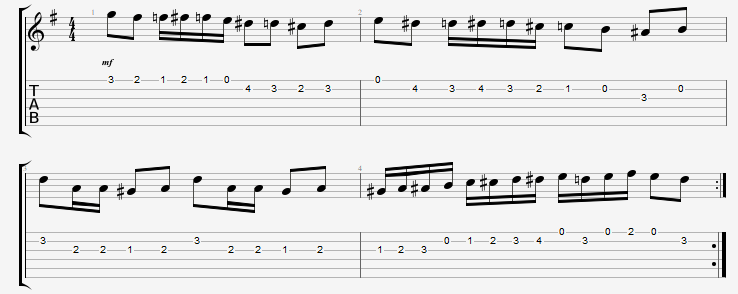
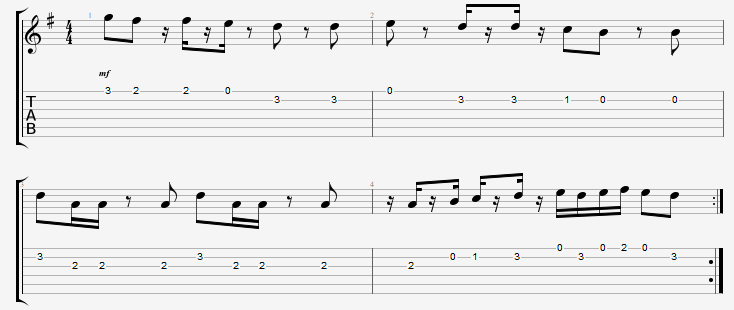
If you are wondering what this might sound like without the “passing tones” (that is, if it was simply and strictly written with scale tones from the key of G), then try the variation below. Note that the melody is now reduced to only scale tones from the key of G Major, and all chromatic tones have been replaced by rests. If you have any trouble reading the rhythm, don’t worry, just play through the notes as best you can so that you can hear the differences. You should be able to clearly hear that the melody is now composed entirely from notes of the G major scale:
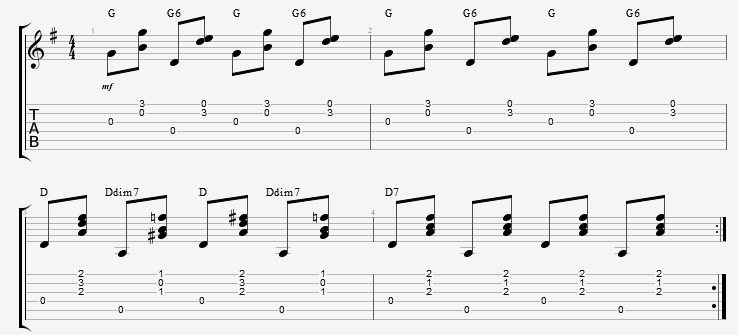
Guitar Rhythm Accompaniment for “Circus Ditty”:
To further enhance your experience of both of the previous melodic variations, it can help to have some chords in the background. So you may want to create a quick backing track for yourself with the voice memo feature on your phone, or some other recording device. Don’t forget to play through the chord progression a number of times to create a backing track that is long enough (at least a minute or two) to support multiple repetitions of your practicing the melody over the top of it. Also, start with a slow tempo version at first, then create increasingly faster backing rhythms to challenge your speed with this piece. It is a ton of fun to play this tune fast – picture a scene where you’ve got to keep those clumsy circus clowns hoppin’!
For an easy backing track version, simply play four beats of a G chord for measures 1 and 2 (eight beats total of G chord), and then play four beats of a D chord over measures 3 and 4 (eight beats total of D chord):

If you are able and want something a little more interesting, try the rhythm below. Notice that there is an “alternating bass” feature to the chords (and therefore the Ddim7 chord is actually a Ddim7/A). Play it as written, or feel free to try other shapes or inversions of the chords according to your tastes!:
About the Author
Craig Tuttle is a professional guitar teacher in Monroe, Wisconsin, USA. He has many years of experience playing and teaching various styles of guitar to students of all ages. Click the link for more info on guitar lessons in Monroe, WI with Craig!